
Choose RINA: your partner combining technology, data security and independent verification for your Digital Product Passport
The Digital Product Passport is a new requirement introduced by the Ecodesign for Sustainable Products Regulation (ESPR) and will become mandatory from 2026 onwards for a growing number of sectors.
The DPP represents the digital identity of a product: a structured set of verifiable information on composition, sustainability, traceability and end of life.
For European companies, compliance is not only a regulatory challenge, but also a strategic opportunity to strengthen trust, reputation and competitiveness within value chains increasingly focused on circularity.
2026
Start of DPP obligations in the European Union
18-36 (months)
Average time for sector‑specific obligations to enter into force after the publication of delegated acts
6+
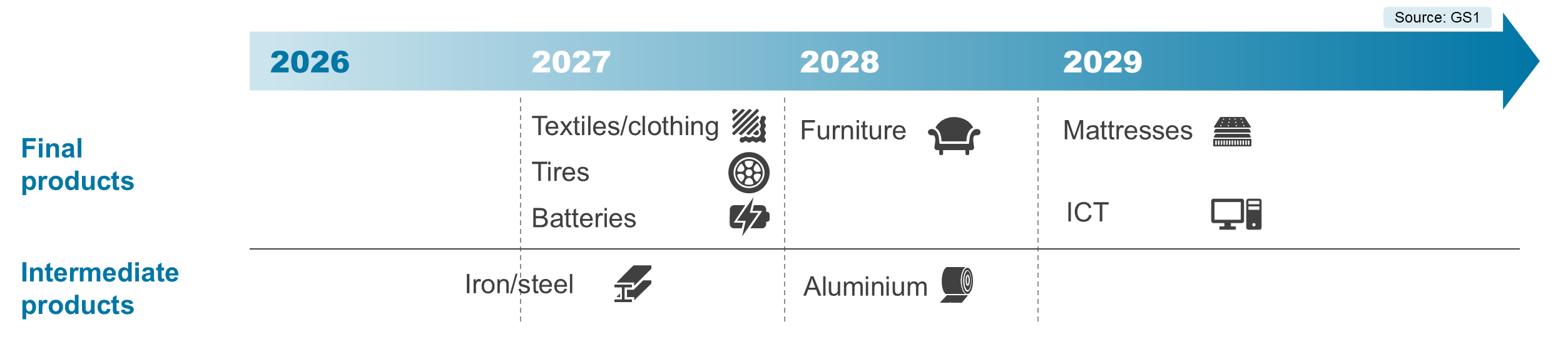
Product categories involved (batteries, iron and steel, construction, textiles, furniture, aluminium, ICT)
3
Levels of access to information (public, restricted to authorised economic operators or restricted to competent authorities)
What we offer
We guide companies through every stage of the Digital Product Passport journey.
As a technology provider, we deliver a platform based on ready to use and customisable templates, designed to create ESPR compliant DPPs and adaptable to any sector. The platform enables secure and segregated data management across the entire value chain, ensuring that each stakeholder accesses only the information relevant to their role. Data are structured around key dimensions (such as composition, sustainability, recyclability and environmental impact) and can be accessed instantly via QR codes or equivalent technologies.
As an independent Certification Body, RINA verifies the accuracy of the information contained in the DPP and issues verifiable credentials, strengthening transparency and reliability.
Choose RINA as your partner: one single solution combining technological flexibility, data security and independent verification.
We are a multinational company with solid experience as an independent certification body.
We support companies in ensuring regulatory compliance and continuous improvement by providing technical expertise, secure data management and digital assurance services, transforming regulatory compliance into innovation.
Impacted sectors
Frequently asked questions
Yes. RINA’s digital services are designed to connect natively with the Digital Product Passport. They already collect and track many of the data required by the DPP, including product information and sustainability claims. Platforms communicate via APIs, ensuring a continuous, consistent and easily integrated data flow.
The implementation of the Digital Product Passport follows a structured five phase approach. It begins with a regulatory and product assessment to define scope and applicable obligations, followed by mapping of available data. A gap analysis identifies areas for improvement, while DPP design defines structure, data flows and integrations. The final phase focuses on scalability and continuous updating, ensuring data governance and alignment with future delegated acts.
Responsibility for the DPP lies with the economic operator placing the product on the European market. However, the passport involves the entire value chain: each actor is responsible for the data related to their specific part of the product.
The platform itself is not the critical factor. What matters is compliance with European standards and data interoperability. The DPP model allows different systems to communicate through common languages and standards, ensuring continuity across the value chain.
Yes, and it is recommended. Companies can begin by structuring data, governance and DPP architecture from the outset. When delegated acts enter into force, content can be integrated or updated without redesigning the entire system.
RINA’s Digital Product Passport platform is designed to integrate with corporate ecosystems and European standards (EBSI, Catena X). It is compatible with ERP systems, data lakes and legacy systems, ensuring a DPP that seamlessly connects with the client’s digital environment.
Through granular authorisations, full event traceability, cryptographic notarisation and secure management of sensitive data using Merkle tree structures. Every step is designed to protect data integrity and confidentiality.


