
Transport & Infrastructure
The Senqu Bridge project is part of the Lesotho Highlands Water Project and stood out for the significant technical complexity it required. The Lesotho Highlands Water Project (LHWP) was designed to divert water from the Senqu-Orange River system to South Africa’s Gauteng province while generating hydropower for Lesotho. The project delivers nearly 800 billion liters of water annually to South Africa's economic heartland, supplying roughly 60% of Johannesburg's water needs.
RINA was engaged by WRES JV, the project contractor led by Webuild, to support the design phase by collaborating on the assessment, implementation, and commissioning of the monitoring system.
In addition to the challenges posed by the local terrain, the monitoring system design pushed industry conventions by implementing and activating the system from the earliest stages of construction rather than waiting until the infrastructure had been completed.
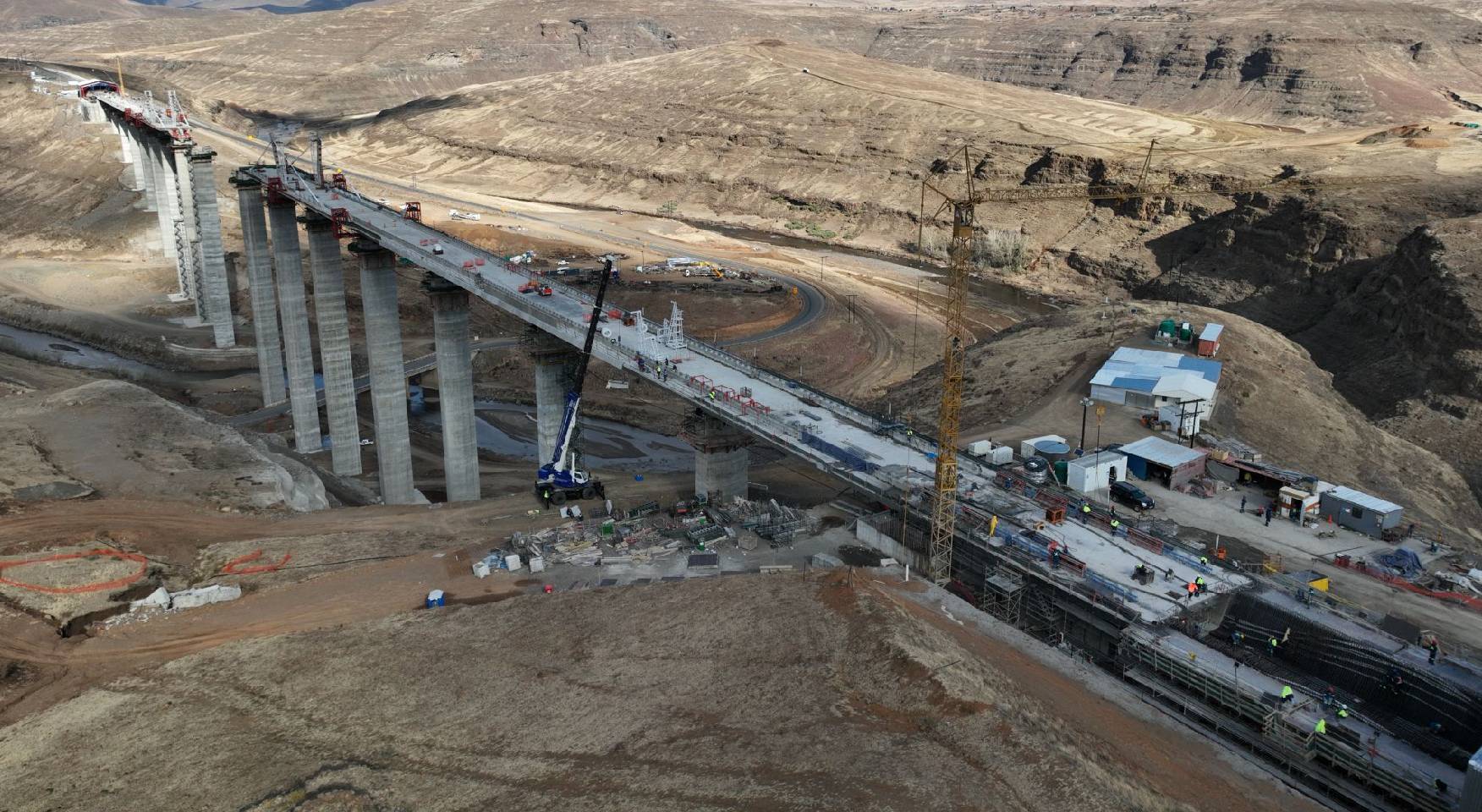
Our team provided specialist expertise in the analysis and design review of the monitoring system, delivering the capabilities required to innovate its implementation directly during the construction phase. We also developed a software platform capable of providing real-time data visualization across seven different monitoring subsystems.
A wide range of technologies were deployed to ensure continuous assessment of the bridge’s structural health and safety under varying environmental conditions. These included Shape Accel Arrays embedded within the post-tensioned deck and pylons to monitor real-time deformation in soil and structures, and vibrating wire strain gauges and thermistors installed during pier and deck casting to measure the concrete hydration temperature.
High-precision inclinometers on the 90-metre central piers were integrated to monitor bridge and pier inclinations during balanced cantilever erection phases, while pressure cells at the abutments and accelerometers on the 100-metre central span were used to study stress development in the concrete during pier construction. Finally, weather stations were deployed to monitor environmental conditions, including air temperature, wind speed, and wind direction.
Our involvement in the Senqu Bridge project was driven by our mission to manage high-complexity challenges by integrating competences and technologies into scalable solutionsin support of the Lesotho Highlands Water Project.
Through close collaboration with designers and contractors, we developed and integrated an active construction support system directly into the structure.
The added value of this approach was the ability to monitor key parameters throughout the entire construction process, rather than only after project completion.
This enhanced quality control, improved safety, and supported more informed decision-making throughout the execution of a highly complex infrastructure project.


