
Throughout much of maritime history, the Arctic was largely inaccessible for commercial navigation due to persistent ice coverage, extreme weather conditions, and limited infrastructure, making regular shipping impractical. However, this scenario is gradually evolving. Climate-induced ice retreat and technological advancements are enhancing seasonal accessibility to Arctic waters, thereby creating new opportunities while simultaneously introducing greater technical, operational, and regulatory complexities. The Arctic should not be perceived as a single route or a straightforward alternative to traditional trade lanes. Instead, it is a complex maritime region composed of several distinct passages, each presenting unique constraints, risks, and requirements.
The Northern Sea Route along the Eurasian Arctic coast is currently the most developed, benefiting from existing infrastructure and support services. In contrast, the Northwest Passage across the Canadian Arctic Archipelago remains challenging due to shallow waters, narrow channels, and complex ice regimes. The Transpolar Sea Route across the central Arctic Ocean remains largely theoretical, with minimal infrastructure and high exposure to severe ice and weather conditions. While Arctic routes may offer reductions in distance and fuel consumption between Asia and Europe, these factors alone do not determine feasibility. Ice conditions remain highly variable even during summer, weather can change rapidly, visibility can be limited, and support services are sparse compared to established shipping lanes. Consequently, Arctic navigation is suitable only for specific vessel types and operational profiles, requiring ice-capable ships, properly trained crews, reliable ice and weather forecasting, and robust safety and emergency preparedness.
From a South Korean perspective, these developments are particularly evident. Busan Port consistently ranks among the top ten busiest container ports worldwide and serves as a major transshipment hub in Northeast Asia. Its infrastructure and connectivity position it as a natural platform to support future Arctic-related maritime activity. Recent decisions by the Korean Government to relocate key maritime institutions and major shipping headquarters to Busan reflect a long-term strategy to consolidate maritime policy, logistics, and industrial capabilities, creating a cluster that is particularly relevant for Arctic operations. In such an environment, close coordination between shipowners, shipyards, ports, and technical partners is essential. Concurrently, the Korean Government has elevated the Arctic Route to a national strategic agenda and is preparing an institutional and legislative framework to support research and development, maritime information systems, and logistics infrastructure. At the international level, Arctic navigation remains governed by UNCLOS and mandatory IMO instruments, most notably the Polar Code, emphasizing that the Arctic is a shared maritime space where cooperation, compliance, and responsible governance are fundamental.
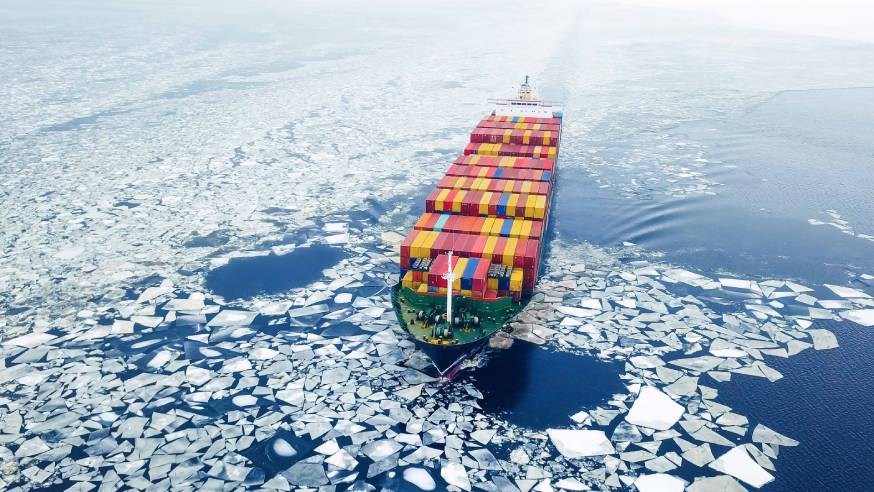
From a technical standpoint, vessels capable of operating in Arctic waters differ significantly from conventional ocean-going ships. These vessels require reinforced hull structures, particularly in the bow, stern, and ice-belt regions, designed to withstand localized ice loads, repeated ice interaction, and fatigue effects. Propulsion and machinery systems must be capable of delivering high torque at low speeds and maintaining reliability during ice milling, ramming, and manoeuvring. Redundancy and robustness are essential design principles due to the remoteness of Arctic operations. Winterisation is equally critical, extending beyond hull and propulsion to include the protection of crew areas, deck machinery, piping systems, air intakes, sensors, and safety equipment, ensuring operability under sub-zero temperatures and icing conditions. These technical measures are framed within classification rules and the IMO Polar Code, which integrates requirements related to ship structure, machinery, operations, crew competence, and environmental protection into a single regulatory framework.
In this challenging environment, the role of a classification society extends beyond compliance verification and becomes one of long-term technical partnership. Arctic navigation requires early and continuous technical involvement to support stakeholders from concept development through construction and operation, ensuring that design choices, risk management strategies, and operational assumptions are technically sound and aligned with regulatory intent. Within the RINA classification framework, Arctic and ice-capable ships may be supported through dedicated ice-strengthening and cold-environment notations addressing hull structure, propulsion and steering robustness, low-temperature operability, and winterisation of systems and equipment. These class notations are complemented by statutory services related to the IMO Polar Code, including design verification, operational limitations, and Polar Ship Certification, providing a coherent technical pathway from concept design to compliant Arctic operation for ships in service and new construction. With 165 years of experience in ship classification, plan approval, risk-based design assessment, RINA acts as a strategic technical partner for shipowners, shipyards, ports, and institutions engaged in Arctic projects, contributing to safe, resilient, and sustainable solutions in one of the most challenging operating environments in global shipping.
This capability is not only theoretical but has been demonstrated through RINA’s active involvement in advanced Arctic vessel developments. In 2025, RINA granted an Approval in Principle (AiP) to a conceptual design for a nuclear-powered Arctic icebreaker developed by Chinese design institutes, intended for multi-role operations including cargo transport and polar navigation. The assessment addressed structural integrity under severe ice loads, icebreaking performance, and the feasibility of innovative propulsion arrangements in extreme polar conditions.
In summary, while the Arctic is becoming more accessible, it remains one of the most demanding operating environments in global shipping. Potential gains in distance must be balanced against increased structural loads, machinery stress, operational constraints, and environmental sensitivity. Arctic navigation is not a routine extension of conventional trade routes but an engineering-driven challenge where design margins, system reliability, and operational discipline determine safety and feasibility.


