Industry
Nowadays the global demand of seafood is growing rapidly, but currently there is a shortage in supply due to the combined effects of:
Further expansion of aquaculture, both land-based and nearshore, is limited for a variety of reasons, such as economic, socio-political, environmental, technical and resource constraints. Moving offshore creates significant advantages and opportunities in meeting the global demand for food especially when the aquaculture system is combined with other activities such as renewable energy production.
The Blue Growth Farm has received funding from the European Union’s Horizon 2020 research and innovation programme under Grant Agreement number 774426 in order to develop and validate an automated, modular and environmentally friendly multi-functional platform design for open sea farm installations of the Blue Growth Industry.
The Blue Growth Farm (BGF) project aims at expanding marine aquaculture capacity through the design of an efficient multi-functional offshore installation, which combines modern automated fish production (up to 5.000 t/y high-quality fish) with generation of renewable energy from wind (10 MW turbine), wave energy converters (WECs), and photovoltaic (PV) panels. Specifically, solar energy powers containerized photobioreactors for microalgae production. The central control system and automation capacity allows the platform to be also operated remotely, ensuring efficiency and safety even in challenging conditions. The platform is built using corrosion-resistant, low-maintenance concrete caisson modules, assembled in floating conditions.
RINA acted as BGF Project Coordinator throughout the project and, during the development phase, was responsible for specific design activities related to the integration of multipurpose platform system technologies. These activities included design of automation and control logic, surveillance and security systems, structural health monitoring system, logistics planning, operations and maintenance (O&M), as well as training and skills/needs development tasks. The project addressed the integration of multiple sub-systems into a single, complex infrastructure, promoting the shared use of assets and marine resources, having as industrial objective to
The overall system concept was validated against the harsh environmental conditions of three representative installation sites: the Mediterranean Sea, the Atlantic Subtropical area, and the Northern Sea.
The complete list of Key Exploitable Results (KERs) developed and managed during the project is presented in the following figure.
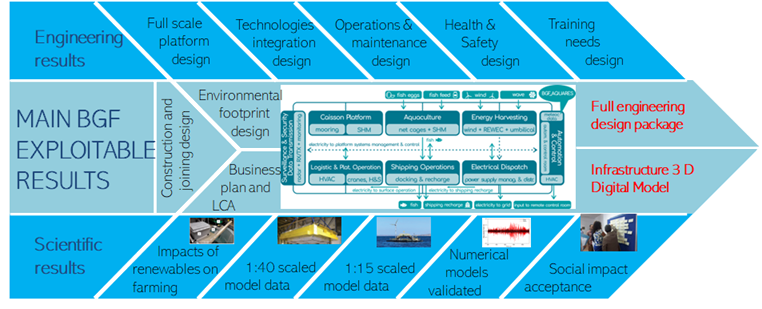
In conclusion, the sustainable exploitation of marine resources relies on the effective combination of aquaculture and offshore renewable energy, supported by appropriate technical expertise, to meet the growing global demand for seafood and renewable energy. The BGF project, in particular, demonstrates a commercially viable model by integrating aquaculture with multiple energy sources on a single platform. Designed, tested at multiple scales, and engineered for deployment across three potential sites, the project highlights the potential for replication in future large-scale offshore resource-optimization initiatives. It also addresses societal acceptance issues associated to such developments and fosters the development of new professional skills and competencies for those engaged in the blue economy.