
Optimize your facility management with RINA North America's cutting-edge technology

Answering the question of “Where?” using cutting-edge technology, RINA provides proactive management of assets to optimize decision-making and management of complex systems and facilities. Interoperability among systems and tracking of performance is essential to helping our clients operate their facilities efficiently.
RINA optimizes performance of assets for campus environments, federal and local governments, and transportation agencies. Our experts offer our clients visibility to make informed decisions, and partner with facility managers to develop cost-effective solutions for the entire life cycle of their various assets. With a focus on the user experience, ease of data access, and change adaptation and management, RINA remains a premier provider of AM/FM services nationwide.

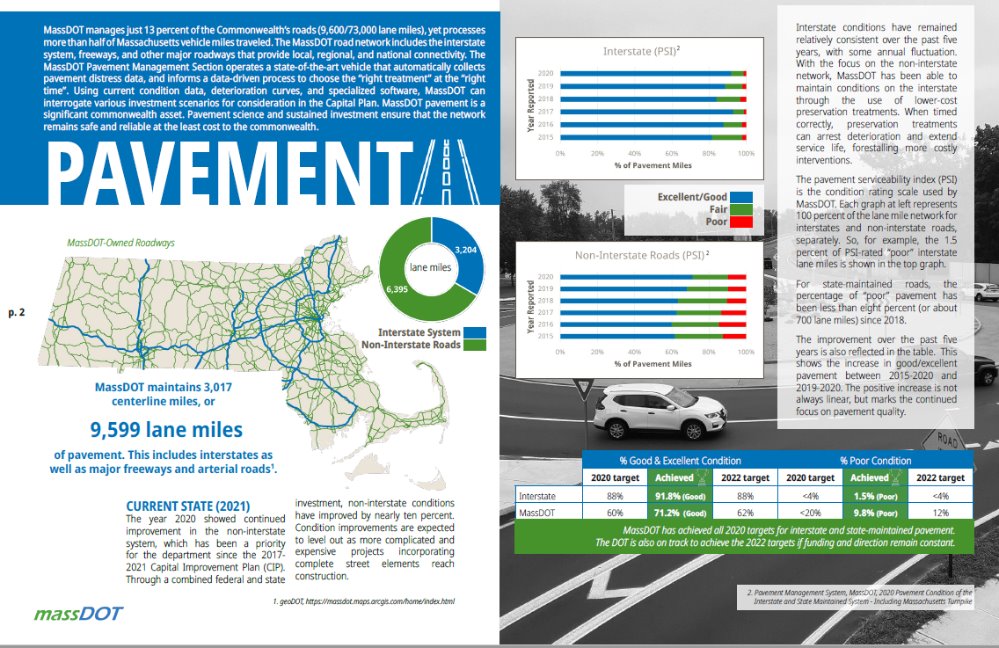
Our team was asked to develop annual reports for the performance and asset management advisory committee. These reports were a snapshot of performance and condition over the past year. They convey transportation needs to the Massachusetts legislature and lobbyists to help them understand what massDOT will be focusing on in the next calendar year.
We did this for three consecutive years. The process included review of materials and data, coordinating with multiple massDOT departments in order to review performance, and develop a visually appealing report for both print and online distribution, meeting all compliance and requirements. The reports conveyed messaging to transportation stakeholders about the projects and asset pefomance across roads, bridges, sidewalks, tunnels, signs, ancillary structures, as well as specialty projects each year.
Central Michigan University (CMU) was looking for a qualified vendor to provide CAD services, GIS data, mapping, and solution implementation services focused on Esri's ArcGIS Indoors technology. CMU contains over six million square feet of building space on their campus in Mount Pleasant, Michigan. With over 15,000 students, the campus manages 115 facilities. To better manage the space, CMU chose a web-accessible GIS solution to visualize floorplan layouts and space types. To best serve CMU's current stated requirements, we assessed CMU data and system readiness to deploy ArcGIS Indoors.
We used our internal CAD team to perform the CAD work. Our staff are very familiar with a variety of methods for extracting and converting space data provided in CAD, BIM, PDF, and other static formats to ArcGIS with data model specifications. This activity also included the setup of extract, translate, load or ETL tools used to automate the process of updating and maintaining ArcGIS Indoors as CMU floorplans change over time. We prepared CMU space plans for ArcGIS Indoors and subsequently configured the ArcGIS Indoors Maps standard apps (e.g., Indoors Viewer, Indoor Kiosk, Mobile, etc. apps). Our team also developed navigable Points of Interest (POIs) based on CMU priority destination points and asset locations.
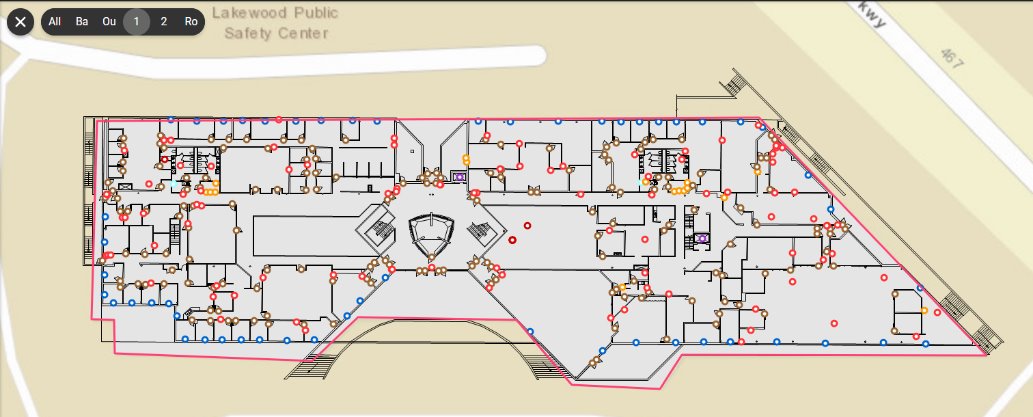
The City of Lakewood sought to modernize how it manages building and recreational facility assets by transitioning from static tools like CAD drawings and spreadsheets to integrated enterprise systems. Building on its existing investments in Cartegraph (Open Gov) and ArcGIS, the City aimed to improve operational efficiency, capital forecasting, and risk mitigation by digitizing facility asset data. We partnered with IndoorVU to capture 360° imagery, CAD floor plans, and GIS data, enabling automated asset identification and direct integration into ArcGIS and Cartegraph. This streamlined what would otherwise have been a highly manual process of entering thousands of assets across multiple buildings.
Once implemented, the system enabled the City to actively manage assets through Cartegraph, including creating work orders, tracking maintenance, managing costs, and developing long-term capital plans. Field teams can now use mobile tools and QR-coded asset tags to quickly locate and update asset information in real time. Additional services, such as facility condition assessments using industry standards, further enhanced forecasting with 20-year maintenance and replacement plans. Overall, the project significantly improved asset visibility, operational workflows, and decision-making, while advancing the City's broader digital transformation goals.
The North Carolina Department of Administration (NCDOA) sought to improve visibility, control, and strategic management of its statewide real property portfolio. We delivered a GIS-based Real Property and Facility Solution that established a centralized, authoritative system for managing assets across the state. This solution enabled more informed decision-making by providing clear insights into property utilization, supporting portfolio right-sizing, and identifying opportunities for investment, divestiture, and asset optimization. Automated workflows improved data consistency and reduced manual effort, allowing state professionals to focus on higher-value planning and policy initiatives.
To support this solution at an enterprise scale, we designed and implemented a secure, cloud-based GIS architecture deployed in Amazon Web Services (AWS). We developed and automated data pipelines to ingest, validate, and maintain authoritative property and facility data, ensuring accuracy, consistency, and long-term reliability. The system integrates with related enterprise systems and business workflows to streamline operations and reduce duplication of effort. Ongoing monitoring, performance tuning, and cost optimization have ensured the platform remains scalable, resilient, and cost-effective, enabling NCDOA to maximize the value of its GIS investment while supporting evolving operational and strategic needs.


